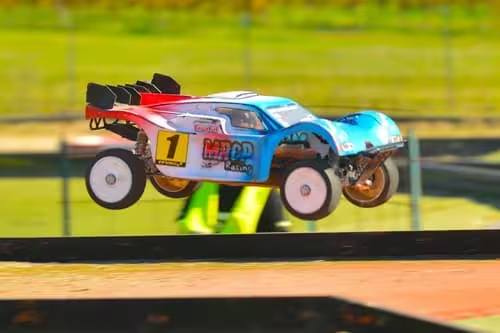
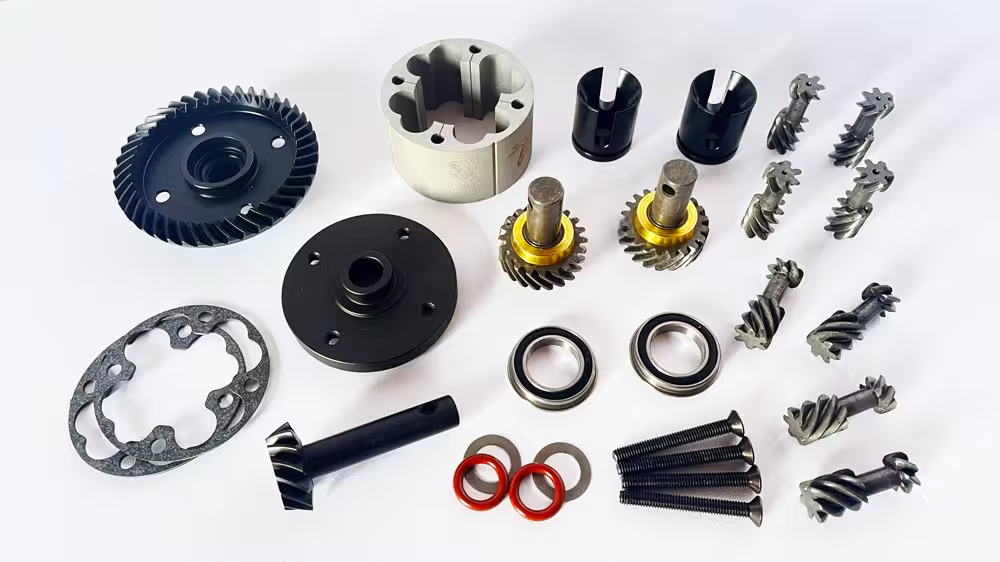
The opening round of the 2026 French Championship at MBC61 delivered an exciting weekend of racing, and we were proud to see French driver Thomas Laigle competing with our Antz Racing Torsen B‑Type front and center differentials.
Despite running a unique vehicle configuration where only the front and center diffs could be equipped with our Torsen system, Thomas demonstrated just how much performance potential the setup offers.
Exceptional Pace from the First Laps
From the very beginning of the event, Thomas showed outstanding speed and consistency. In the semi‑final, he secured 1st place, showcasing the strong acceleration, stability, and cornering balance provided by the Torsen system.
According to Thomas, the front Torsen differential delivered impressive steering authority, while the center Torsen provided powerful and efficient drive on corner exit. The combination allowed him to push hard without suffering from oversteer or understeer, giving him a confident and predictable driving platform.
He also noted that the car tracked extremely straight under power and rewarded precise throttle control — a characteristic that helped him carry excellent speed through technical sections.
A Podium Finish — and Nearly a Victory
In the final, Thomas once again demonstrated race‑winning pace. He built a full‑lap lead over second place and was on track to take a dominant victory.
However, with just 30 seconds remaining, his fuel tank ran dry — the only factor that prevented him from converting his performance into a win. He still crossed the line in 3rd place, securing a strong podium finish and proving the competitiveness of the Torsen setup at the highest level of French 1/5 racing.
It’s important to highlight that the loss of the lead was purely due to fuel depletion, not a performance issue. The pace, stability, and acceleration throughout the race clearly showed the potential of the Torsen system in competition.
Driver Feedback and Future Development
Thomas shared valuable insights after the race:
The front Torsen provides strong steering response and precise direction control.
The center Torsen delivers excellent acceleration and traction, especially on corner exit.
The car maintains high stability under power, allowing fast and confident driving.
In wet or slippery conditions, the Torsen setup gives a noticeable advantage in acceleration compared to other drivers.
His feedback will help us continue refining the system and exploring new development options — including potential upgrades for different vehicle platforms and fuel tank configurations.
A Strong Start to the Season
We are extremely pleased with Thomas’s performance and proud to see our Torsen differentials proving themselves in top‑level competition. A semi‑final win, a podium in the final, and race‑leading pace all weekend show the strength of the package.
With further fine‑tuning and continued collaboration, we’re excited to see what Thomas can achieve in the next rounds of the championship.
The 2026 season has only just begun — and this is a very promising start.
The Torsen B‑type differential has no internal adjustment for torque distribution or locking force. Unlike an open gear diff, you cannot tune it by changing oil. However you can influence how the Torsen behaves through external conditions.
A Torsen works based on: Throttle input + Left / right traction difference + Gear geometry
Below are five ways you can control how much the Torsen locks.
1. Throttle Input (Engine Power)
Torsen locking comes from: Input torque × Gear engagement angle = Self‑locking force
More throttle → stronger locking
Less throttle → freer, more like an open diff
This is why a Torsen feels smooth, linear, and easy to control.
On a large‑scale gas vehicle like the Losi 5T, differential configuration is more than a technical choice — it defines how the car behaves and how much driving pleasure you can extract from it. The Torsen mechanical LSD, known for its linear response, predictable torque biasing and zero‑maintenance design, gives the 5T a completely different personality depending on where it is installed. Whether you run it in the front, center, rear, or in various combinations, each setup transforms the steering feel, traction balance and overall dynamics of the truck. The following section explores how each configuration changes the driving experience and which scenarios it is best suited for.
Configuration 1: Rear Torsen Only (Front/Center remain stock gear diffs)
Recommended Setup:
Front Diff: Stock gear diff (medium or light oil)
Center Diff: Stock gear diff (heavier oil to stabilize front–rear torque balance)
Smoother and more planted corner exit: When left–right traction is uneven, the Torsen sends more torque to the wheel with grip, reducing single‑wheel spin.
A “smarter” rear end: Unlike thick‑oil rear diffs that cause understeer, or light‑oil diffs that make the rear loose, the Torsen follows the ground naturally.
Improved throttle control: Especially during half‑throttle exits, the car feels less aggressive and more stable.
Best Suited For:
Medium‑ to high‑grip dirt, artificial soil, or tracks with ruts and bumps
Drivers who control rotation with throttle but don’t want the rear to step out too easily
Losi 5T used for track running, off‑road racing, or practice sessions—ideal for experiencing Torsen benefits without major setup changes
Not Ideal For: Very low‑grip surfaces (loose sand) + drivers who rely on “tail‑out” rotation → A more locked‑style rear diff may be preferable.
Configuration 2: Center Torsen Only (Front/Rear remain stock gear diffs)
Rear Diff: Stock gear diff (slightly heavier oil to stabilize the rear)
Driving Characteristics:
Smarter front–rear torque distribution: Under throttle, the Torsen sends more torque to the end with traction, reducing front or rear wheelspin.
More linear acceleration: Especially after bumps or jump landings, the car avoids sudden traction loss.
Overall stability improvement: On a large 4WD platform like the 5T, the center diff is the “main distributor,” and the Torsen greatly enhances adaptability.
Drivers who already understand stock diffs and want to upgrade the car’s “core behavior”
Not Ideal For: Drivers who rely heavily on center‑diff oil tuning to adjust front/rear balance → The Torsen reduces this “oil‑based tuning space” and becomes more self‑adjusting.
Configuration 3: Center Torsen + Rear Torsen (Front remains stock)
In the world of 1/5‑scale RC performance, few platforms command as much respect as the Losi 5ive‑T 2.0. Its size, weight, and power make it one of the most capable large‑scale trucks on the market. But with great power comes great demand on the drivetrain — and one component in particular has long been the weak link: the differential.
Open differentials are predictable and inexpensive, but they struggle under high torque, aggressive throttle inputs, and uneven terrain. Anyone who has pushed a 5ive‑T 2.0 hard knows the symptoms:
Sudden one‑wheel spin
Loss of traction on loose surfaces
Weak corner‑exit acceleration
Unstable high‑speed behavior
Premature diff wear
To solve these issues once and for all, we developed a dedicated Torsen (Torque‑Sensing) differential specifically engineered for the Losi 5ive‑T 2.0 (to be listed soon). This is not a modified stock diff, not a universal LSD, and not a silicone‑dependent tuning solution. This is a true mechanical Torsen B‑type differential, built from the ground up for large‑scale RC performance.
This article will walk you through the engineering behind the design, the performance benefits, and why this upgrade transforms the 5ive‑T 2.0 into a completely different machine.
What Is a Torsen Differential?
“Torsen” stands for Torque Sensing — a type of automatic limited‑slip differential that uses helical gears to distribute torque between wheels.
Unlike silicone‑filled diffs or clutch‑based LSDs, a Torsen diff:
Uses no oil viscosity to create resistance
Uses no clutch plates that wear out
Reacts instantly to traction changes
Requires zero maintenance
Provides continuous, smooth torque transfer
When one wheel loses traction, the Torsen automatically sends more torque to the wheel with grip. No electronics. No tuning. No delay.
This makes it ideal for high‑power RC platforms where traction varies constantly — especially off‑road.
Why We Chose the Torsen B‑Type Design
There are three major Torsen architectures: Type A, Type B, and Type C. For the Losi 5ive‑T 2.0, the B‑type is the perfect match.
Antz Racing proudly introduces its very first performance upgrade: the Losi 5T 2.0 Torsen Type B Differential. This launch marks a milestone for Antz Racing, combining years of expertise in engineering, materials, and drivetrain dynamics into a product designed to redefine performance for the Losi 5T 2.0 platform. As their debut upgrade part, it reflects Antz Racing’s philosophy of precision, durability, and control.
Compared to the stock differential, the Torsen Type B stands out with its torque-sensing mechanism. Standard diffs often allow one wheel to spin freely under extreme conditions, wasting power and reducing stability. The Torsen Type B, however, automatically distributes torque to the wheel with the most grip, ensuring that power is always directed where it is needed most. This results in smoother power delivery, improved cornering stability, and enhanced traction across all terrains.
Key advantages include:
Durability: Built with high-strength materials and precision machining, it withstands heavy loads and reduces wear.
Smooth power transfer: Eliminates sudden wheel spin and unpredictable handling.
Superior handling: Maintains stability during high-speed cornering and on uneven terrain.
Performance across surfaces:
Asphalt: Sharper steering response and precise control.
Mud: Reduced wheel spin, improved acceleration.
Gravel/Off-road: Stronger traction and stability.
Astro turf: Rapid adaptation to changing grip levels, preventing loss of control.
For competitive racers, this means faster lap times and more consistent performance. For hobbyists, it ensures a more enjoyable and reliable driving experience. As Antz Racing’s first performance upgrade, the Torsen Type B Differential is more than just a component—it’s a statement of intent, signaling the brand’s commitment to innovation in the RC performance market.
Since its founding in 2010, XRider has established itself as a pioneer in the specialized world of radio‑controlled motorcycles. While most RC brands focus on cars, trucks, or buggies, XRider dedicated its engineering to the unique challenge of two‑wheeled balance and realism. This focus has allowed the company to create models that not only look authentic but also perform competitively on asphalt, dirt, and AstroTurf tracks.
The CX3 series was XRider’s breakthrough. Compact and accessible, the CX3 Air and CX3 EVO gave hobbyists an entry point into RC motorcycles without sacrificing handling quality. The EVO version introduced improved gyro stabilization, making it easier for beginners to control while still offering enough performance for experienced racers.
XRider then expanded into larger scales. The Saturn and Mars (1/8 scale) models brought more power and durability, appealing to competitive racers who wanted speed and precision. The Scorpio and Sagittarius (1/5 scale) pushed boundaries even further, introducing features like chain‑drive transmissions, metal swing arms, and advanced gyro systems. These models blurred the line between hobby‑grade RC and true motorsport engineering.
One of XRider’s most distinctive contributions is the Cafe Racer. Inspired by the 1960s British motorcycle culture, this model combines retro styling with modern RC technology. With its low handlebars, elongated tank, and minimalist tail, the Cafe Racer appeals to enthusiasts who value both performance and cultural authenticity. It demonstrates XRider’s ability to diversify its product line beyond pure racing machines.
XRider’s achievements extend beyond hardware. The company has cultivated a strong global community, with active forums, social media groups, and race events where XRider bikes frequently dominate. Their models are praised for stability in corners, realistic lean angles, and the ability to handle diverse track surfaces.
By combining innovation, scale realism, and competitive performance, XRider has redefined what RC motorcycles can achieve. For hobbyists seeking more than just speed—for those who want the authentic feel of two‑wheeled racing in miniature—XRider remains the benchmark brand.
In the global RC community, KKPIT has become synonymous with performance, durability, and innovation. Founded by a team of engineers and enthusiasts, the company has grown from a small chassis developer into a complete ecosystem provider for competitive RC racing. What sets KKPIT apart is its relentless focus on combining cutting‑edge engineering with the passion of real racers, ensuring that every product is designed not only for speed but also for reliability and ease of use.
Product Lines
Cars & Chassis: The KONE series dominates short course racing with balanced handling, while KBT trucks and KPM monster trucks deliver raw power for off‑road tracks. For drift enthusiasts, the PDK platform provides precision control and tunable geometry.
Parts & Upgrades: From high‑strength alloy suspension arms to carbon fiber shock towers, every upgrade is engineered for competitive advantage. Precision gears and adjustable differentials allow racers to fine‑tune performance.
Setup Tools: Professional kits for camber, toe, and ride height adjustment, plus ESC and motor tuning tools, give racers the ability to replicate pro‑level setups.
Assembly & Accessories: Aerodynamic bodies reduce drag, reinforced wheels and tires maximize grip, and protective roll cages extend chassis life.
Key Features
Modular design: Components can be swapped or upgraded without replacing the entire chassis.
Durability: Alloy and composite materials withstand crashes and long‑term use.
Aerodynamics: Optimized airflow improves cornering stability and top speed.
Accessibility: Platforms are suitable for both beginners learning setup basics and professionals chasing podium finishes.
Track‑tested reliability: Every product is validated in real racing conditions before release.
Quality & Reputation
KKPIT has built a reputation for precision engineering and competitive reliability. Each chassis undergoes rigorous testing, ensuring that it can withstand the demands of high‑intensity racing. The brand has earned the trust of RC enthusiasts worldwide by consistently delivering products that balance innovation with practical usability.
Global Reach & Community
KKPIT is not just a manufacturer but also a community builder. Through partnerships with distributors like Antz Racing, racers worldwide gain access to the same high‑quality engineering and support. Tutorials, setup guides, and race‑proven tips are shared to help both newcomers and seasoned drivers get the most out of their machines.
Explore the full KKPIT range at Antz Racing and take your RC racing to the next level.
At Antz Racing, we are committed to delivering the most advanced and exciting RC products to enthusiasts worldwide. From high-performance cars to hyper-realistic motorcycles, our portfolio covers the full spectrum of RC passion.
KKPIT Full Product Line
KKPIT is a premium RC car brand known for its modular chassis, durability, and race-ready performance.
On-road racing: KONE, K1, and KBT chassis designed for speed and precision.
Off-road power: KPM monster trucks and KBT desert buggies built for rugged terrain.
Drift series: PDK and KONE Drift platforms for smooth, controlled slides.
Upgrade ecosystem: Brushless power systems, suspension kits, and tuning parts for every skill level.
Whether you’re chasing podiums on the track or tackling extreme off-road challenges, KKPIT delivers uncompromising performance.
X-Rider Full Product Line
X-Rider specializes in RC motorcycles, combining scale realism with thrilling control.
1/4 Scale Sagittarius (CRS): Inspired by the Honda CRF-250R, featuring flywheel gyro stabilization, mechanical disc brake, and alloy spoked wheels.
1/8 Scale Mars & Saturn: Balanced between realism and racing performance.
1/5 Scale Scorpio: A large-scale motorcycle with commanding presence and handling.
Specialty models: Café Racer, Flamingo trike, and Firebird scooter — unique designs for collectors and riders alike.
X-Rider motorcycles are more than models — they are a fusion of engineering precision and riding excitement.
Future Development: High-Performance Upgrades for Large-Scale Models
Beyond our current lineup, Antz Racing is actively developing next-generation upgrade parts for large-scale RC vehicles.
Our flagship project in development is the:
5T Model B-Type Torsen Differential
Torque-sensing design: The B-type Torsen uses parallel-axis helical gears to automatically distribute torque where it’s needed most.
Wide adaptability: Unlike the A-type (optimized for high torque bias in sports cars), the B-type is a versatile, multi-purpose model suitable for front, center, or rear differentials.
Performance benefits: Improved traction on uneven terrain, smoother cornering, and enhanced stability under high power loads.
Ideal for large-scale RC: Perfect for 1/5 and 1/6 scale vehicles that demand both strength and precision.
This innovation will bring real automotive-grade technology into the RC world, giving large-scale enthusiasts a new level of control and reliability.
Conclusion
At Antz Racing, you’ll find the complete KKPIT RC car lineup and the full X-Rider motorcycle range, backed by our ongoing commitment to innovation. With the upcoming B-type Torsen differential for 5T models, we are pushing the boundaries of what’s possible in large-scale RC performance.
Stay tuned for more updates, and join us as we continue to redefine the RC experience.