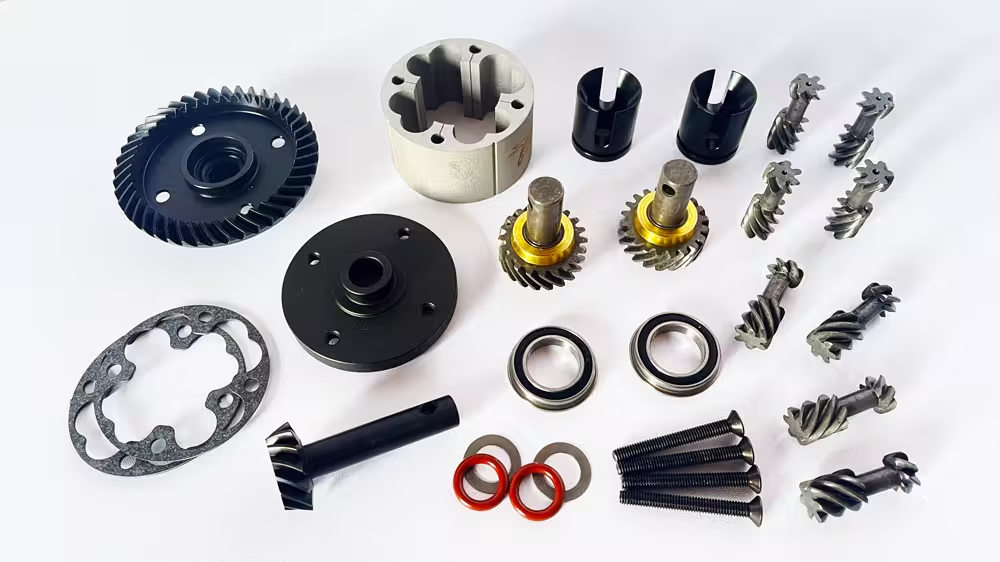
The Torsen B‑type differential has no internal adjustment for torque distribution or locking force. Unlike an open gear diff, you cannot tune it by changing oil. However you can influence how the Torsen behaves through external conditions.
A Torsen works based on: Throttle input + Left / right traction difference + Gear geometry
Below are five ways you can control how much the Torsen locks.
1. Throttle Input (Engine Power)
Torsen locking comes from: Input torque × Gear engagement angle = Self‑locking force
More throttle → stronger locking
Less throttle → freer, more like an open diff
This is why a Torsen feels smooth, linear, and easy to control.
On a large‑scale gas vehicle like the Losi 5T, differential configuration is more than a technical choice — it defines how the car behaves and how much driving pleasure you can extract from it. The Torsen mechanical LSD, known for its linear response, predictable torque biasing and zero‑maintenance design, gives the 5T a completely different personality depending on where it is installed. Whether you run it in the front, center, rear, or in various combinations, each setup transforms the steering feel, traction balance and overall dynamics of the truck. The following section explores how each configuration changes the driving experience and which scenarios it is best suited for.
Configuration 1: Rear Torsen Only (Front/Center remain stock gear diffs)
Recommended Setup:
Front Diff: Stock gear diff (medium or light oil)
Center Diff: Stock gear diff (heavier oil to stabilize front–rear torque balance)
Smoother and more planted corner exit: When left–right traction is uneven, the Torsen sends more torque to the wheel with grip, reducing single‑wheel spin.
A “smarter” rear end: Unlike thick‑oil rear diffs that cause understeer, or light‑oil diffs that make the rear loose, the Torsen follows the ground naturally.
Improved throttle control: Especially during half‑throttle exits, the car feels less aggressive and more stable.
Best Suited For:
Medium‑ to high‑grip dirt, artificial soil, or tracks with ruts and bumps
Drivers who control rotation with throttle but don’t want the rear to step out too easily
Losi 5T used for track running, off‑road racing, or practice sessions—ideal for experiencing Torsen benefits without major setup changes
Not Ideal For: Very low‑grip surfaces (loose sand) + drivers who rely on “tail‑out” rotation → A more locked‑style rear diff may be preferable.
Configuration 2: Center Torsen Only (Front/Rear remain stock gear diffs)
Rear Diff: Stock gear diff (slightly heavier oil to stabilize the rear)
Driving Characteristics:
Smarter front–rear torque distribution: Under throttle, the Torsen sends more torque to the end with traction, reducing front or rear wheelspin.
More linear acceleration: Especially after bumps or jump landings, the car avoids sudden traction loss.
Overall stability improvement: On a large 4WD platform like the 5T, the center diff is the “main distributor,” and the Torsen greatly enhances adaptability.
Drivers who already understand stock diffs and want to upgrade the car’s “core behavior”
Not Ideal For: Drivers who rely heavily on center‑diff oil tuning to adjust front/rear balance → The Torsen reduces this “oil‑based tuning space” and becomes more self‑adjusting.
Configuration 3: Center Torsen + Rear Torsen (Front remains stock)
In the world of 1/5‑scale RC performance, few platforms command as much respect as the Losi 5ive‑T 2.0. Its size, weight, and power make it one of the most capable large‑scale trucks on the market. But with great power comes great demand on the drivetrain — and one component in particular has long been the weak link: the differential.
Open differentials are predictable and inexpensive, but they struggle under high torque, aggressive throttle inputs, and uneven terrain. Anyone who has pushed a 5ive‑T 2.0 hard knows the symptoms:
Sudden one‑wheel spin
Loss of traction on loose surfaces
Weak corner‑exit acceleration
Unstable high‑speed behavior
Premature diff wear
To solve these issues once and for all, we developed a dedicated Torsen (Torque‑Sensing) differential specifically engineered for the Losi 5ive‑T 2.0 (to be listed soon). This is not a modified stock diff, not a universal LSD, and not a silicone‑dependent tuning solution. This is a true mechanical Torsen B‑type differential, built from the ground up for large‑scale RC performance.
This article will walk you through the engineering behind the design, the performance benefits, and why this upgrade transforms the 5ive‑T 2.0 into a completely different machine.
What Is a Torsen Differential?
“Torsen” stands for Torque Sensing — a type of automatic limited‑slip differential that uses helical gears to distribute torque between wheels.
Unlike silicone‑filled diffs or clutch‑based LSDs, a Torsen diff:
Uses no oil viscosity to create resistance
Uses no clutch plates that wear out
Reacts instantly to traction changes
Requires zero maintenance
Provides continuous, smooth torque transfer
When one wheel loses traction, the Torsen automatically sends more torque to the wheel with grip. No electronics. No tuning. No delay.
This makes it ideal for high‑power RC platforms where traction varies constantly — especially off‑road.
Why We Chose the Torsen B‑Type Design
There are three major Torsen architectures: Type A, Type B, and Type C. For the Losi 5ive‑T 2.0, the B‑type is the perfect match.
Antz Racing proudly introduces its very first performance upgrade: the Losi 5T 2.0 Torsen Type B Differential. This launch marks a milestone for Antz Racing, combining years of expertise in engineering, materials, and drivetrain dynamics into a product designed to redefine performance for the Losi 5T 2.0 platform. As their debut upgrade part, it reflects Antz Racing’s philosophy of precision, durability, and control.
Compared to the stock differential, the Torsen Type B stands out with its torque-sensing mechanism. Standard diffs often allow one wheel to spin freely under extreme conditions, wasting power and reducing stability. The Torsen Type B, however, automatically distributes torque to the wheel with the most grip, ensuring that power is always directed where it is needed most. This results in smoother power delivery, improved cornering stability, and enhanced traction across all terrains.
Key advantages include:
Durability: Built with high-strength materials and precision machining, it withstands heavy loads and reduces wear.
Smooth power transfer: Eliminates sudden wheel spin and unpredictable handling.
Superior handling: Maintains stability during high-speed cornering and on uneven terrain.
Performance across surfaces:
Asphalt: Sharper steering response and precise control.
Mud: Reduced wheel spin, improved acceleration.
Gravel/Off-road: Stronger traction and stability.
Astro turf: Rapid adaptation to changing grip levels, preventing loss of control.
For competitive racers, this means faster lap times and more consistent performance. For hobbyists, it ensures a more enjoyable and reliable driving experience. As Antz Racing’s first performance upgrade, the Torsen Type B Differential is more than just a component—it’s a statement of intent, signaling the brand’s commitment to innovation in the RC performance market.